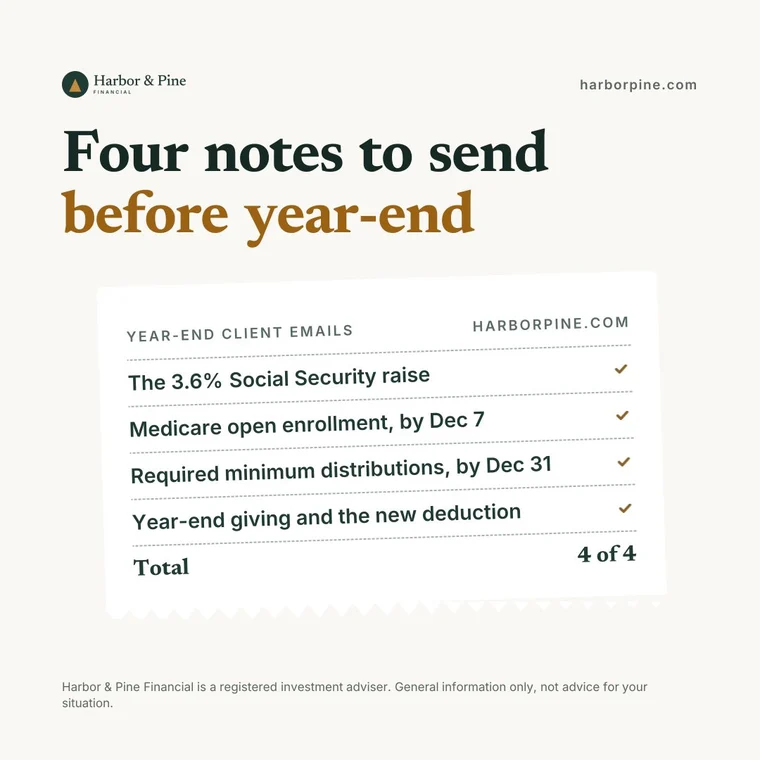
Financial advisors can email clients a short run of year-end notes tied to dates people already care about. For 2026, that's the 3.6% Social Security raise for 2027, Medicare open enrollment before December 7, the required minimum distribution deadline on December 31, year-end giving and the new limits for 2027 as they come out. Each note works best when it's short, written for the clients it actually affects and sent while there's still time to act.
October through December is the one stretch of the year when the news hands you a reason to write almost every week. The catch is that each announcement matters to a different slice of your clients, and a single note to everyone tends to feel like it wasn't written for anyone.
Here's what to send, when to send it, and how to keep the season from eating your evenings.
Why Are Year-End Emails Worth the Effort?
Year-end emails are worth it because they reach clients at the exact moment they're hearing about a change somewhere else. When a client reads about the Social Security raise on the news, a note from you that same week answers the question they were about to ask.
Steady contact pays off too. In The Kitces Report's 2026 marketing study, advisors who sent newsletters about 36 times a year won a new client from them 33% of the time, compared with 14% for those sending 12 a year. The newsletter group in that study was small, so I'd read it as a direction more than a promise, but it points the same way as everything else Kitces found about consistency.
The good news is that year-end gives you the topics for free. You don't have to invent anything, only explain what changed and what it might mean for the people you serve.
What Should You Tell Clients About the 2027 Social Security Raise?
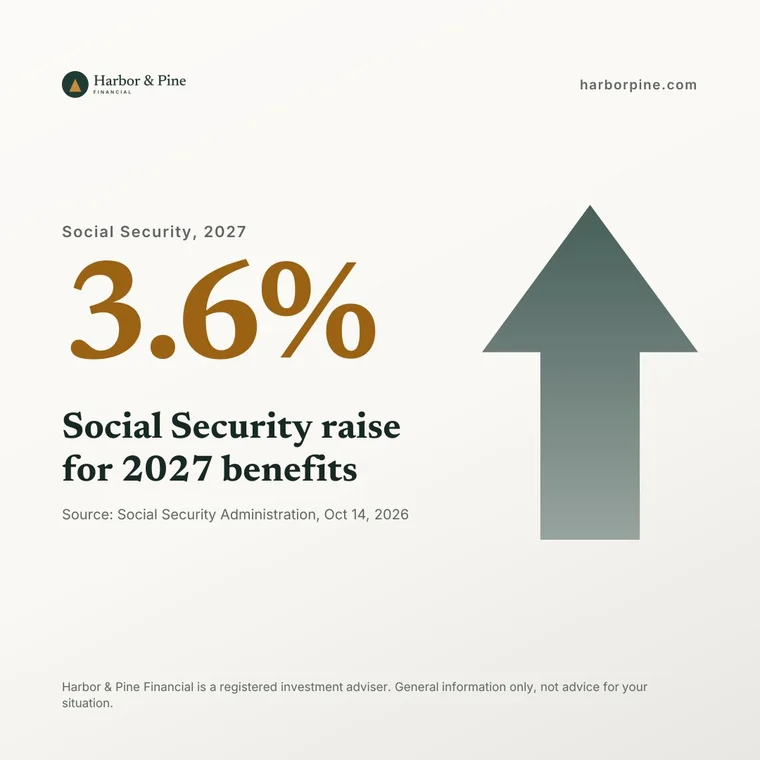
Tell clients the number, when it starts and what might take part of it back. The Social Security Administration announced a 3.6% cost-of-living adjustment on October 14, 2026, the largest since 2023, and it starts with January 2027 benefits.
Timing helps you here. According to HousingWire's October 14 report, beneficiaries can see their new amount in their my Social Security account starting in late November, and paper notices go out in December. A short note before then means you're the one who explained it first.
Worth noting, the Medicare Part B premium for 2027 isn't out yet, and it comes out of the same check for many retirees. The 2026 Medicare Trustees Report projects $209.50 a month, up from $202.90, but that's a projection, so I'd say plainly that you'll send the real number once Medicare announces it.
How Should You Remind Clients About Medicare Open Enrollment?
Remind clients early and give them the deadline. Medicare open enrollment runs from October 15 to December 7, according to Medicare.gov, and changes take effect January 1.
This one only matters to clients on Medicare or close to it, plus the ones helping a parent who is. For everyone else, it can wait or become a single line in a broader note.
The most useful version of this email is simple. Tell them the window is open, that plans and drug coverage change from year to year, and that it's worth a quick look before December 7. Then invite them to talk it through if they'd like a second set of eyes.
When Should You Send the RMD Reminder?
Send it in November, with a short follow-up in early December. December 31 is the deadline for most required minimum distributions, according to the IRS, and a reminder in November leaves time to act without the holiday rush.
The detail clients tend to miss is the first RMD. The IRS lets someone delay their first one until April 1 of the following year, but then two distributions land in the same year, which can push up that year's tax bill. A one-sentence mention of that tradeoff is plenty for an email, and the real decision belongs in a conversation.
Keep account details out of the email itself. A friendly "this is the time of year we take care of it" and an offer to confirm the plan does the job.
What's New About Year-End Giving in 2026?
What's new is a deduction for clients who don't itemize. Starting with tax year 2026, people who take the standard deduction can deduct up to $1,000 of cash gifts to qualified charities, or $2,000 for married couples filing jointly, according to IRS Topic 506.
That matters because many clients assumed small gifts did nothing for their taxes. The IRS rules are specific, though. Only cash or check gifts to qualifying charities count, so donated stock, clothing and gifts to donor-advised funds don't qualify for this deduction.
For a year-end email, that's an easy, encouraging note for clients who give a little each year. It's also a natural lead-in to a conversation with clients who give more, where the right approach depends on their situation.
What About the New Limits for 2027?
Send those as they're published, not before. The IRS has already set the 2027 health savings account limits at $4,500 for self-only coverage and $9,000 for family coverage, with a $1,000 catch-up at age 55 and older, in Revenue Procedure 2026-24.
The 2027 tax brackets, standard deduction, and 401(k) and IRA limits weren't out as of October 19, 2026. The IRS usually publishes them in October or November, so it's worth waiting for the official numbers rather than sending a projection that changes a week later.
When they do come out, this is a great email for working families and younger clients, who often hear about a higher 401(k) limit on a podcast and wonder if they're supposed to do something.
How Do You Decide Which Clients Get Which Email?
Decide by the kind of client, not the client list. A retiree, a family in their forties and a business owner each care about a different announcement, so it helps to sort your clients into a few groups and write one version for each group the change touches.
For the groups a change doesn't affect, one friendly line is better than silence. Telling a 35-year-old that the Social Security raise doesn't change anything for them yet, and that you're keeping an eye on what does, shows you're paying attention on their behalf.
Compliance still applies to each version. If you're an RIA, the SEC Marketing Rule and the books and records rules shape what you send and what you keep, and if you're with a broker-dealer, FINRA Rule 2210 and your firm's procedures decide what needs approval. Keep names and account details out, label projections as projections, and save specific recommendations for a documented conversation. The compliance-first approach to AI content walks through a review process that doesn't slow you down.
Should Your Year-End Emails Become Posts Too?
Yes, most of them can. The same announcement that earns a client email makes a useful public post, and it reaches prospects who are wondering about the same thing your clients are.
A post about the Social Security raise, a reminder that Medicare open enrollment ends December 7, or a plain explanation of the new charitable deduction all fit the content calendar you may already be keeping for the quarter. Write the post for the public, with no client details, and link to your own site or booking page.
That's where the hours add up, though. Several emails for different kinds of clients, plus the posts and graphics that go with them, is a lot to draft in the busiest season of the year, and it's the kind of work that's easiest to hand off first while you keep the judgment and the final say.
Watt, the Amplify for Advisors Agent
See Watt solve this.
Paste your website once, and Watt drafts a week of posts with graphics in your voice and brand, ready for you to approve.
This week · ready for your review
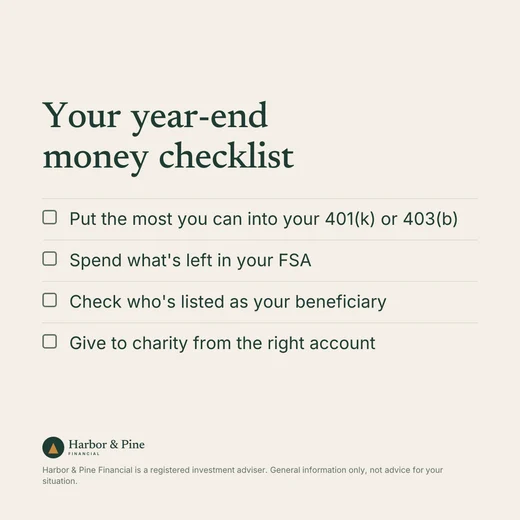


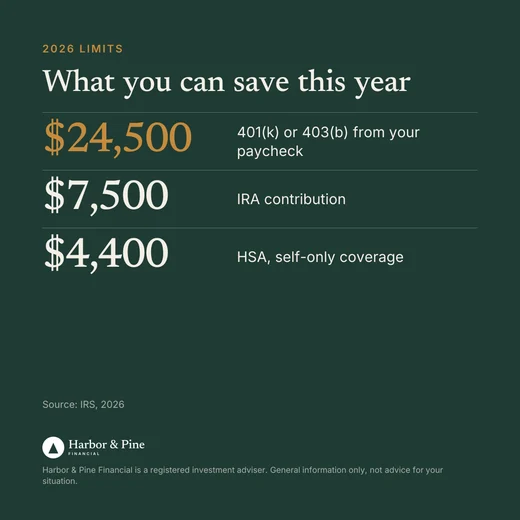

Open now. Watt drafts a week of posts, emails and graphics in your voice, with no client data needed.
Start your 7-day free trialThe Bottom Line for Advisors Planning Year-End Emails
Year-end gives you a reason to write nearly every week, and the best emails are short, timely and written for the clients each change actually touches. For 2026, that's the 3.6% Social Security raise, Medicare open enrollment before December 7, the December 31 RMD deadline, the new charitable deduction for people who don't itemize and the 2027 limits as the IRS publishes them.
Pick the first one this week, sort your clients into a few groups and send it before they read about it somewhere else.
The client who hears it from you first tends to remember who told them.

Sam is the creator of Amplify for Advisors and Watt, the Amplify for Advisors Agent. A former RIA owner whose work has been featured in Forbes, NerdWallet, Nasdaq, and more, he teaches financial advisors to use AI in their own voice while staying compliant.