A blog earns its place on your website when each post answers a question the people you serve are typing into Google or ChatGPT. A blog like that becomes the part of your website that Google and AI tools can find, quote and send people to. A blog that's a string of market updates and firm news usually costs more time than it gives back.
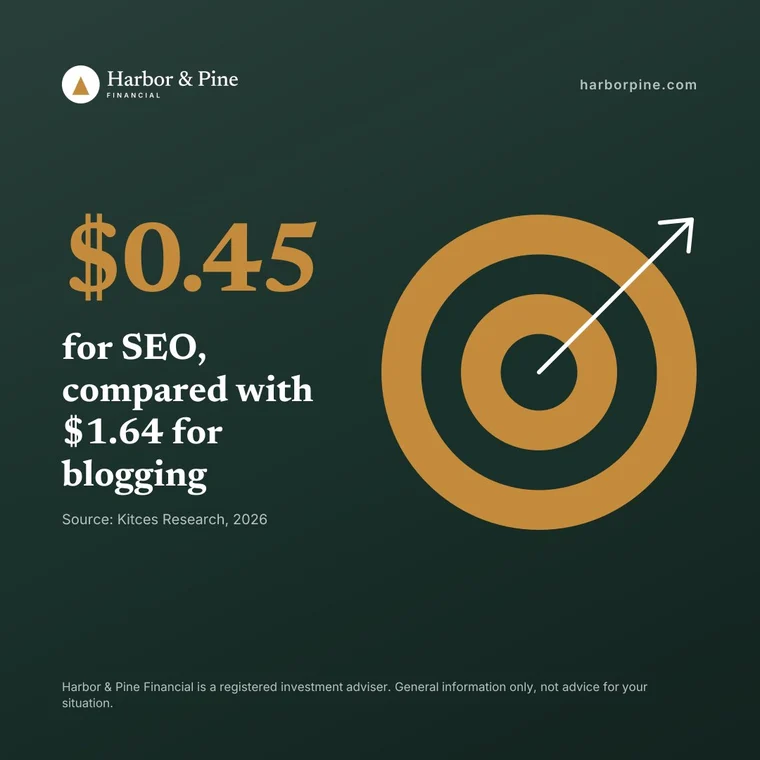
The numbers make the difference pretty clear. In The Kitces Report's 2026 marketing study, advisors spent about $1.64 in blogging for every $1 of new annual revenue it brought in, compared with about $0.45 for search engine optimization. The good news is that you don't have to pick one. A blog written for search is SEO, and that's the version worth your time.
Here's how to decide whether you need one, what to write and how to keep it going without it taking over your week.
Do Financial Advisors Still Need a Blog in 2026?
If you want to be found by people who don't know you yet, a blog is one of the simplest ways to do it. Referrals still bring in many advisors' best clients, but even a referred prospect often looks you up first, and what they find on your site is what they judge you by.
That search now happens in AI tools as often as in Google. A study from the PR firm Gregory, reported by WealthManagement.com on October 28, 2026, looked at 8,389 answers from ChatGPT, Gemini and Google AI Overviews to questions affluent professionals ask when looking for an advisor. Firms' own websites were cited in 89.5% of those answers, far ahead of directories and media.
So the pages on your site do real work. A homepage and a services page can say who you help, but a blog is where you answer the specific questions those people are asking.
Does Blogging Actually Bring In New Clients?
It can, but blogging on its own is one of the more expensive ways to find a client. Kitces put blogging's cost at about $1.64 per dollar of new revenue, more than double the typical practice's overall figure of about $0.70 across every kind of marketing.
About 27% of practices blog, according to Financial Planning's coverage of the study, and many of them write the kind of post that's hard to find. A recap of last quarter's markets or a note about the office holiday party might be pleasant to read, but nobody types those into a search bar.
The posts that bring in clients look different. They answer one question a real person asks, they say who they're written for, and they stay useful for years instead of weeks.
What's the Difference Between Blogging and SEO?
Blogging is publishing posts on your site, and SEO is making your site easy to find when someone searches. They overlap when a post is written to answer a question people search for, and that's where the Kitces numbers get interesting.
SEO came in at about $0.45 per dollar of new revenue, one of the cheapest tactics in a study that compared 26 of them. Online advisor directories were cheaper still at about $0.28. Both reward the same thing, which is a clear description of who you help that a stranger can find.
A blog post written for search does double duty. It's content for your clients and newsletter, and it's also the page that shows up when a stranger asks Google or ChatGPT the same question. If you'd like to go deeper on the search side, the guide to writing content AI tools cite covers it step by step.
What Should a Financial Advisor Blog About?
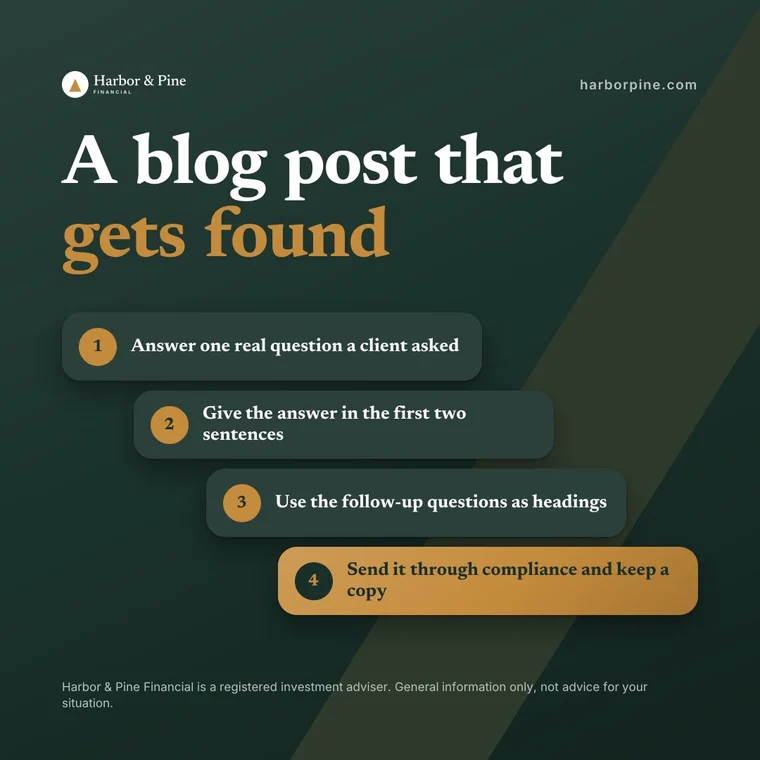
Write about the questions your clients ask you, in the words they use. Every meeting gives you a few, like whether to pay off the mortgage before retiring, what to do with an old 401(k) or how a sabbatical changes a plan.
Your niche makes this easier. The Gregory study found firms that serve one group showing up far more often than their size would suggest. Dentist Advisors, a Salt Lake City firm that works with dentists, was the fourth most mentioned firm at 7% of answers, ahead of many national names.
Seasonal questions are the other good source. Open enrollment, year-end giving, tax deadlines and new contribution limits all send people searching, and the content calendar guide lists the dates worth writing around.
How Should You Write a Blog Post So People Find It?
Answer the question in the first two sentences, then explain. Search engines and AI tools tend to quote openings that answer directly, and readers who only need the short version get it right away.
Use the follow-up questions a reader would ask as your headings. If the post is about rolling over an old 401(k), the headings might ask how long it takes, what it costs and what happens to company stock, each answered in its first line.
Name the people you're writing for and where you work, the way you'd say it out loud. A post that says it's for teachers in the Denver area is easier to match to a teacher in Denver than one written for everyone.
How Often Should a Financial Advisor Publish a Blog Post?
Once a month is a pace many advisors can keep, and keeping it matters more than the exact number. Twelve useful posts a year add up to twelve questions your site can answer, and each one keeps working long after you publish it.
If you have more time, two a month is a good stretch. If you have less, one strong post a quarter still beats a burst of five in January and nothing after, since a blog whose last post is two years old can make a prospect wonder if you're still around.
Length should follow the question. I'd aim for somewhere around 800 to 1,500 words, long enough to answer the question and the obvious follow-ups without padding.
Do Financial Advisor Blog Posts Need Compliance Approval?
Yes, plan on it. If you're an RIA, a post that offers your advisory services can be an advertisement under the SEC Marketing Rule, and your firm keeps a copy under its books and records rules. Michael Kitces has made the point that whether you're with an RIA or a broker-dealer, the basics are the same, which is review before it goes out, nothing misleading and an archived copy.
If you're with a broker-dealer, FINRA Regulatory Notice 10-06 treats static blog posts as advertisements under Rule 2210, which need a principal's approval before they're posted. Comments and live back-and-forth are treated differently, so your firm's procedures decide how those are handled.
Educational posts clear review faster than promotional ones. Skip predictions, performance claims and anything that sounds like a promise, and the compliance-first approach to AI content walks through a review routine that fits a monthly schedule.
How Do You Get More From Each Blog Post?
Use every post at least three times. Send it in your newsletter, turn its main point into a LinkedIn post, then bring it back a few weeks later with a different angle from the same article.
That's where a blog stops feeling like extra work. One article a month can feed your newsletter and several weeks of social posts, and the client newsletter guide shows how an article can anchor an issue.
Meet Watt, the marketing agent for financial advisors.
Monthly newsletters, website articles, social posts and graphics, all in your brand and your voice.
Paste your website and Watt learns your brand.

- Your colors
- AaAaYour fonts
- Your logo
- Your voice
Your week of posts, drafted for you.




Your monthly newsletter, written for you.
- Sounds like you
- Links to your website articles
- Your disclosure added
More than 50 client handouts, in your brand.
Nothing goes out until you approve it.
- infPosts to LinkedIn and Facebook on time
- Newsletter ready to send
- A copy for your records
About 10 minutes a week
About ten minutes a week. Nothing goes out until you approve it.
Start your 7-day free trialWatt builds this into its plan. It drafts a website article each month in your voice, and each approved article comes back as a new post two weeks later and again six weeks later, each time making a different point, with every piece waiting for your approval.
The Bottom Line for Advisors Thinking About a Blog
A blog is worth having when each post answers a question the people you serve are searching for. Written that way, it's search engine optimization, one of the cheapest ways advisors brought in clients in the 2026 Kitces study, and it's the kind of page AI tools cite when someone asks for help.
Start with one question a client asked you this month and answer it in the first two sentences. That's your first post.

Sam is the founder of Amplify for Advisors and Watt, the Amplify for Advisors Agent. A former RIA owner whose work has been featured in Forbes, NerdWallet, Nasdaq, and more, he teaches financial advisors to use AI in their own voice while staying compliant.