Repurposing means you do the thinking once and let one good idea show up everywhere your clients and prospects already look. One article becomes your newsletter, your posts and your graphics for the month, and nobody has to know it all started on the same afternoon.
It matters because the expensive part of content isn't the software or the design. It's you. In The Kitces Report's 2026 marketing study of 506 advisors, advisor time made up about 69% of the total cost of content marketing, compared with 57% for other kinds of marketing.
Here's how to pick the right piece, what it can turn into and how to spread it across a month without anyone feeling like they're reading the same thing twice.
Why Should Financial Advisors Repurpose Their Content?
Because writing from scratch for every channel is where content marketing gets expensive. The Kitces study found content creation had an average cost of about $1.99 for every $1 of new annual revenue it brought in, which made it the third least cost-effective kind of marketing in the report.
Many advisors have noticed. The share of advisors using at least one content tactic fell from 60% in 2024 to 51% in 2026, with the biggest drops in newsletters and blogging.
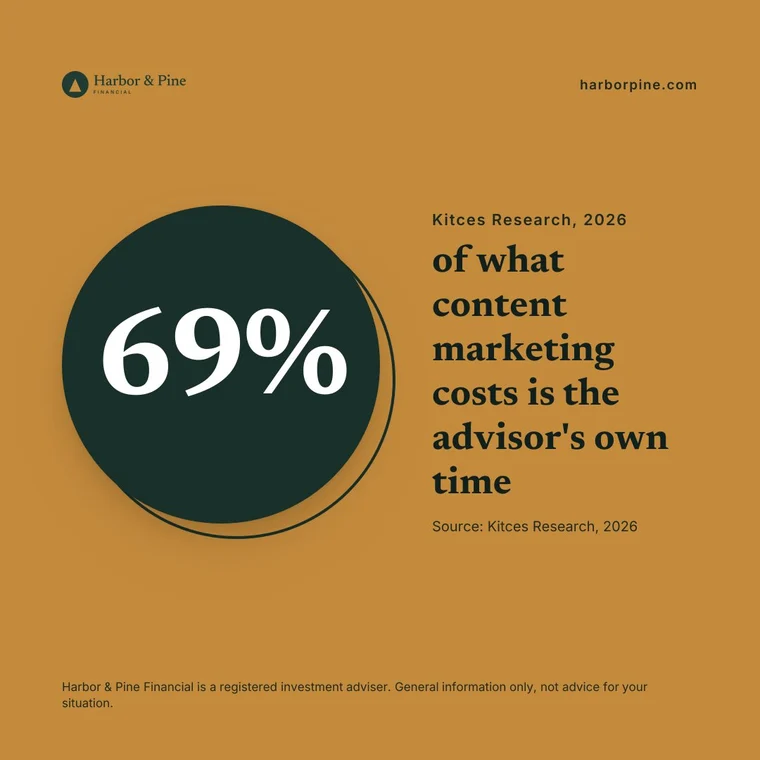
The good news is that the cost is mostly your hours, and repurposing is a direct way to get more from each one. Kitces also noted that larger firms keep content going because a marketing team can handle everything after the advisor creates the piece, the editing, posting and distribution. Repurposing gives a solo advisor a version of that same setup.
What Makes a Good Article to Repurpose?
Start with a question a client asked you in the last month. If one person asked it out loud, plenty of others are wondering about it, and the answer will still be useful a year from now.
Good candidates have one main idea, a clear example and a few natural follow-up questions. Whether to pay off the mortgage before retiring, what to do with an old 401(k) or how to think about a year-end bonus all work well, because each has a short answer, a longer explanation and a few angles you can pull apart later.
Market recaps are the hardest to reuse. They're stale in a week, and a post about last month's index returns doesn't age into anything useful. The guide to whether you need a blog covers how to write the original piece so people can find it.
What Can One Article Turn Into?
One solid article can easily become a newsletter issue, three or four social posts, a simple graphic and a follow-up post a few weeks later. That's a month of presence from one afternoon of writing.
The newsletter version is the easiest. Lead with the question, give the short answer and link to the full article, so the issue stays short and the article does the heavy lifting. The client newsletter guide shows how one main idea can anchor an issue.
The social posts each take one piece of the article. One might be a quick tip, another a short story from the example you used, another a single number with a sentence of context, and another a question that invites replies. Each stands on its own, so someone who never reads the article still walks away with something useful.
How Should Each Platform Version Be Different?
Keep the idea the same and change the shape. LinkedIn tends to reward a few short paragraphs with a clear point, Facebook works best when the post sounds like you talking to a neighbor, Instagram leans on the graphic with a short caption, and X wants the idea in a sentence or two.
The words should change too. A post that's copied word for word onto four platforms often reads like a press release on at least three of them, and readers notice.
If you're short on time, start with the one or two platforms where your clients already spend time. Doing two well beats doing four halfway.
How Do You Spread One Article Over a Month?
Give each week one job. Week one, publish the article and send it in your newsletter. Week two, post the strongest tip from it. Week three, share the graphic. Week four, post a story or question that points back to the article.
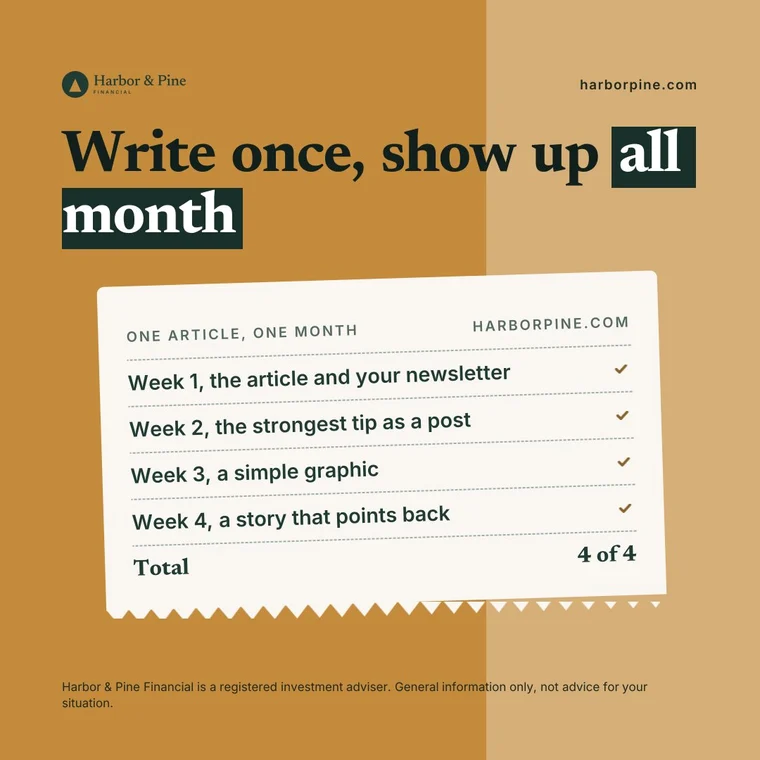
Then bring it back. A few weeks later, the same article can carry a new post with a different angle, especially if a client question or a headline makes it timely again. The content calendar guide lists the dates that tend to bring old articles back to life.
Will People Get Tired of Seeing the Same Idea?
Far less than you'd think. For most kinds of content, Kitces found that publishing more often was linked with more success at bringing in new clients, and the report pointed to the importance of consistency and repetition in building trust.
Many people in your audience won't see every post, and the people who do usually need to hear an idea a few times before it sticks. A new angle on the same idea reads as consistency, and it's how you become known for the things you care about.
Do Repurposed Posts Need Their Own Compliance Review?
Yes, plan on it. A shorter version can change the meaning of something that was carefully worded in the full article, and a post that drops a qualifier can end up saying more than you meant.
If you're an RIA, a post that offers your advisory services can be an advertisement under the SEC Marketing Rule, and your firm keeps a copy under its books and records rules. If you're with a broker-dealer, FINRA treats static social posts as communications that need a principal's approval before they go up, so your firm's procedures decide how each version gets reviewed.
Repurposing can make review easier. When every post comes from an article compliance has already seen, each version is a short check against something familiar, and the compliance-first approach to AI content walks through a review routine that fits a monthly rhythm.
Should You Repurpose Content Yourself or Get Help?
Help pays off here more than almost anywhere else. In the Kitces study, advisors who fully outsourced social media had a cost of about $0.45 per dollar of new revenue, compared with $1.77 for those who did it all themselves and $4.17 for those who handed off only part of it.
Blogging showed the same pattern. Practices that fully outsourced their blog content found it successful 38% of the time, compared with 27% for those writing in-house.
The catch is that outside help often doesn't sound like you. The middle path is a tool that turns your article into the newsletter, posts and graphics in your own voice and leaves the final say with you.
Meet Watt, the marketing agent for financial advisors.
Monthly newsletters, website articles, social posts and graphics, all in your brand and your voice.
Paste your website and Watt learns your brand.

- Your colors
- AaAaYour fonts
- Your logo
- Your voice
Your week of posts, drafted for you.



Your monthly newsletter, written for you.
- Sounds like you
- Links to your website articles
- Your disclosure added
More than 50 client handouts, in your brand.
Nothing goes out until you approve it.
- infPosts to LinkedIn, Facebook, Instagram and X on timeFacebook and Instagram business accounts
 Newsletter ready to sendDrafted in your Mailchimp or Kit
- A copy for your records
About 10 minutes a week
About ten minutes a week. Nothing goes out until you approve it.
Start your 7-day free trialWatt builds repurposing into its plan. It drafts a website article each month in your voice, turns it into newsletters, social posts and graphics in your brand, and brings each approved article back as a new post two weeks later and again six weeks later, each time making a different point. Nothing goes out until you approve it.
The Bottom Line for Advisors Who Want More From Every Article
Repurposing is how you get a month of content from one good idea. Write one article that answers a real client question, turn it into a newsletter, a few posts and a graphic, and bring it back with a new angle a few weeks later.
The 2026 Kitces data says your time is the biggest cost in content marketing. Spending it once and using the result four or five times is the most practical way to keep showing up.

Sam is the founder of Amplify for Advisors and Watt, the Amplify for Advisors Agent. A former RIA owner whose work has been featured in Forbes, NerdWallet, Nasdaq, and more, he teaches financial advisors to use AI in their own voice while staying compliant.